
- SMS Reply Automation
- Existing and New Auto Replies
- Auto-Replies Settings
- Dynamic Responses with an External API
SMS Reply Automation
With Auto Replies, you can automate SMS-enabled phone numbers to respond to inbound SMS messages with account-specific answers, links, or MMS media.
Replies can be keyword-related and be static (always the same message) or, using an external API, you can set up dynamic responses.
Automatic replies can include images or files and be scheduled for specific dates or times. If you create multiple auto-replies for a number, you can set priorities to determine the order in which they are delivered.
Existing and New Auto Replies
The Auto Replies screen is accessed at Admin Center Menu>SMS Features>Auto Replies. It lists auto replies by Phone Number, Name, Type (Static Text or External API), and Status (Enabled, Disable, or that its schedule has Expired).
You can delete auto replies by checking them and clicking  , but be aware that this cannot be undone. Clicking
  on the Starred column will add an auto reply to the home page Starred Features panel for fast access.
Select  on the top-right to download a CSV list of existing auto replies. Use
  to search for specific auto replies.
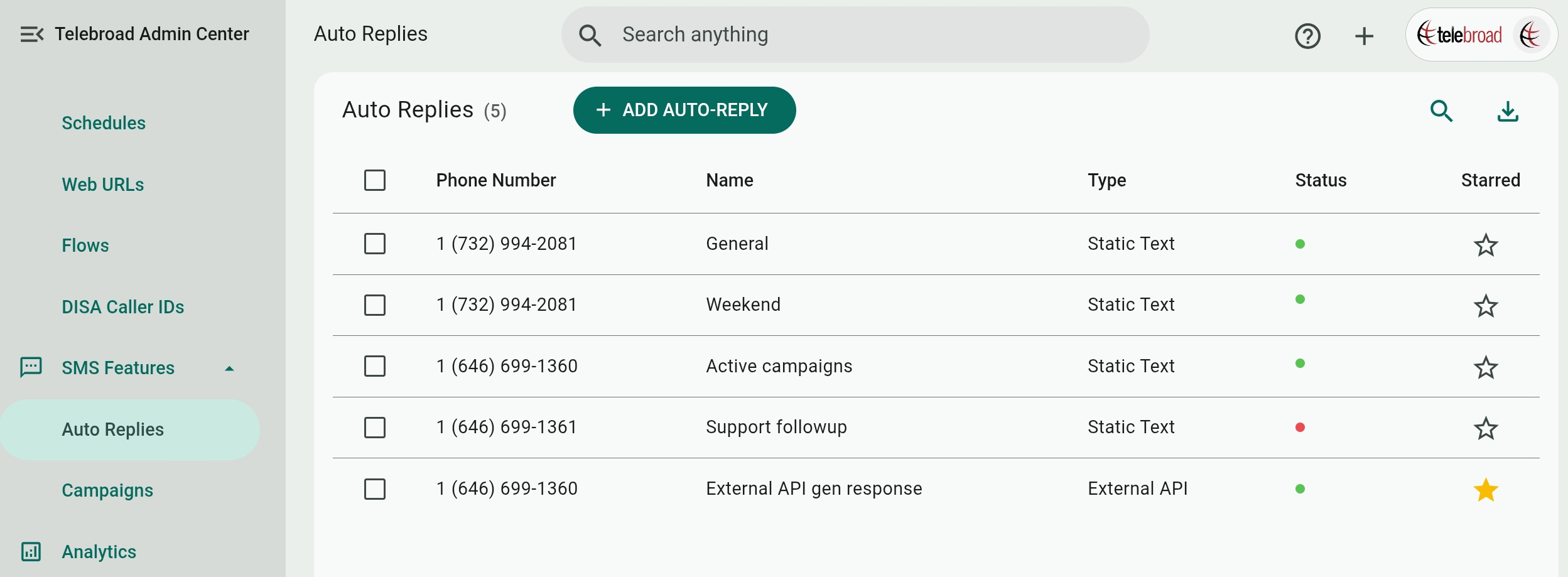
Selecting ADD AUTO-REPLY creates a new auto-reply and directs you to its settings page (see next).
Auto-Replies Settings
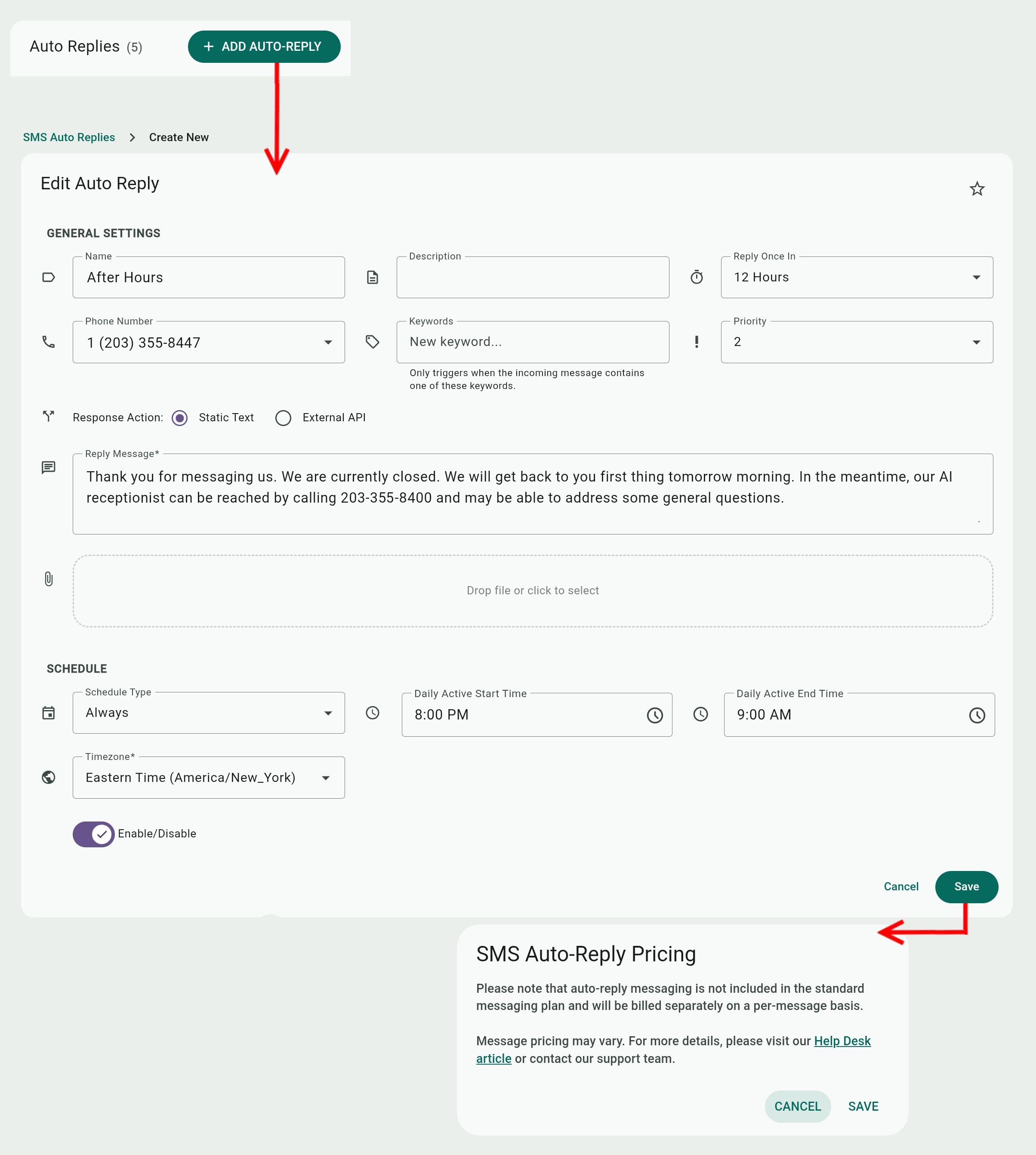
Select any auto-reply or create a new one to show and configure its settings.
- Name/Description: Self-explanatory. The description is optional.
- Phone Number: Select the phone number to send auto-replies from.
- Reply Once in: Select the frequency of replies — Once Per Phone Number or every 1-12 hours, every 1-6 days, every1-3 weeks, or once a month.
- Default Message/Attachment: Enter the text of the auto-reply message.
(optional) Drag-and-drop or select a file in the Attachment field to be included with the auto-reply message. - Keywords: Enter any keywords to trigger the auto-reply. If these keywords are not found in a message, the auto-reply will not be sent.
For multiple entries, you can press Enter on your keyboard after each keyword, or click outside the Keywords box.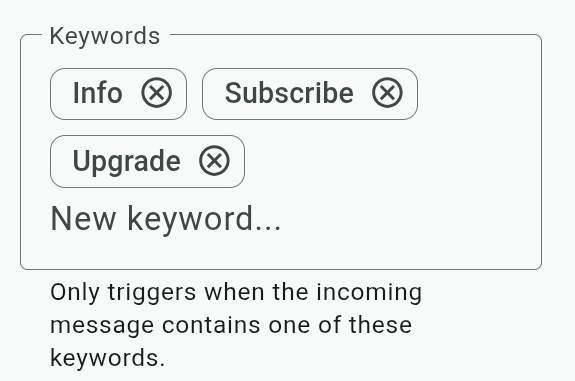
Note that the 'start', 'stop', and 'help' keywords as they are reserved by the system. - Priority: Select an auto-reply priority from 1 (highest) to 10 (lowest).
If you have auto-replies for the same number with the same schedule, the highest priority SMS will be delivered first. - Response Action: Select to respond with a Static Text – always the same message, or External API – a dynamic message that is handled by a script on an external server. External API is explained below.
For Static Text, provide the Reply Message, and you can also attach a file (optional). Attaching a file will convert the message to MMS, which is priced at a flat rate. See more about SMS/MMS pricing in this article. - Schedule: Set a schedule for when the auto-reply is active. For the Schedule Type, selecting Always will have the schedule active daily, or you can select specific Days of Week, Days of Month, or a Date Range.
- Daily Active Start Time/Daily Active End Time/Timezone: CTIA Messages Best Practices and The Campaign Registry (TCR) require that you avoid sending messages during quiet hours — generally 9 pm to 8 am. Here you can limit the message delivery to a specific time range to respect quiet hours.
You should also consider the recipient's Timezone and set this option to reflect it.
However, since you are not initiating the communication but replying to a message, it can be assumed the sender expects an instant reply, even if not during quiet hours. To accommodate this and reply 24 hours a day, you can set the Start Time to 12 AM and the End Time to 11:59 PM.
Only one pair of Start and End times can be set per schedule. If you need the schedule to be active more than once in any day, you would need to create a copy of it.
- Daily Active Start Time/Daily Active End Time/Timezone: CTIA Messages Best Practices and The Campaign Registry (TCR) require that you avoid sending messages during quiet hours — generally 9 pm to 8 am. Here you can limit the message delivery to a specific time range to respect quiet hours.
- Enable/Disable: A toggle that allows you to temporarily disable an auto-reply instead of deleting it.
Dynamic Response with an External API
By selecting External API for the Response Action option, you can auto-reply to messages with a dynamic message that is generated by a script on an external server and returned to the Telebroad system as a JSON-formattted API response. Any server-side scripting language can be used as long as it can return the response with the parameters discussed below.
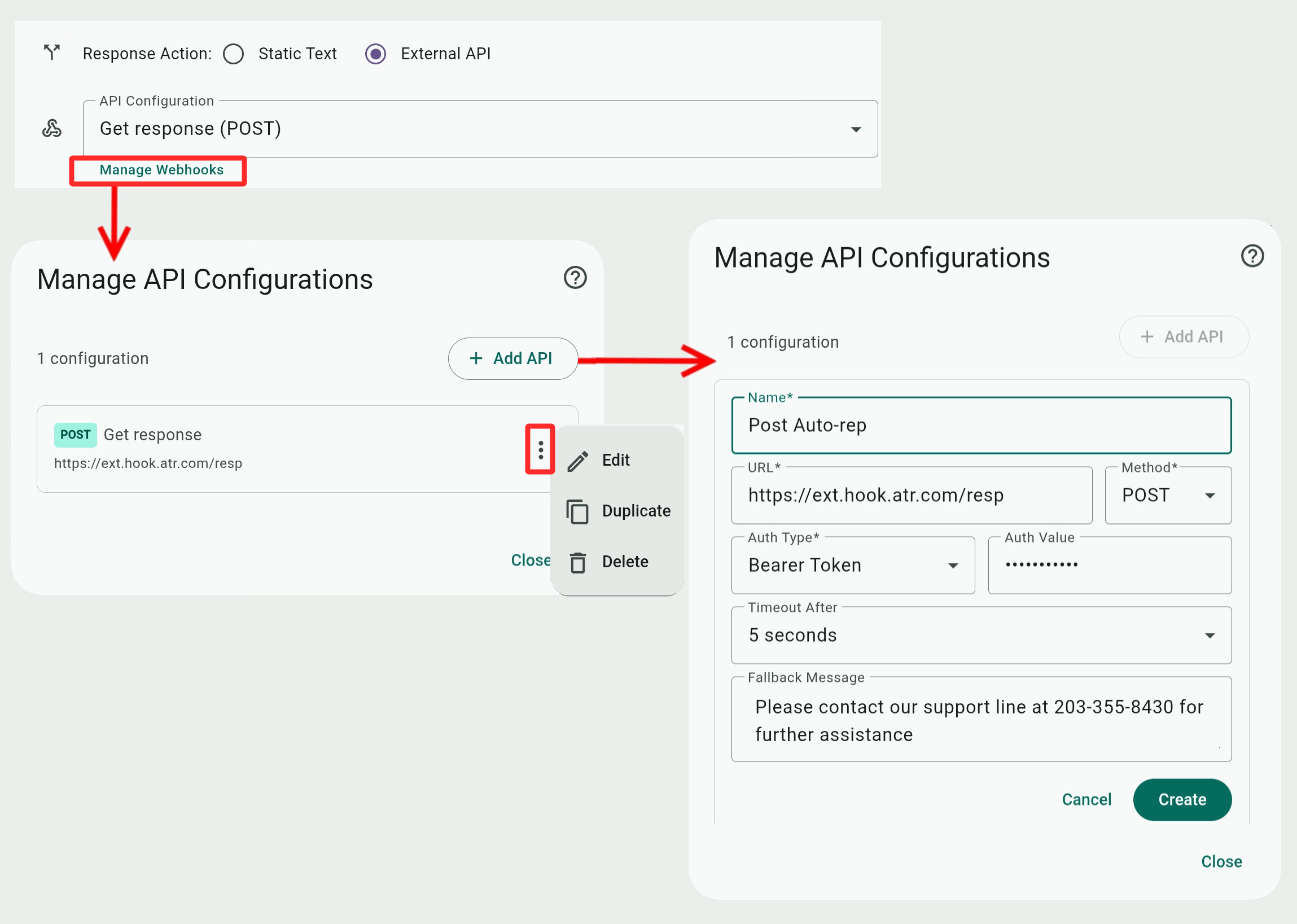
In the API Configuration list, you can select existing API connections or select Manage Webhooks to access the list where you can Edit, Duplicate, or Delete configurations or create a new one with the Add API option.
API Configuration Parameters
- Name: Self-explanatory.
- URL: The server address the auto-reply will contact using the API request.
- Method: The communication method to handle the API request. See explanation of the request parameters below.
- The POST method is the most common and will send the SMS data to the external server in the body of the request.
The request body looks like this —
{
"auto_reply_id": 1785250937,
"sender": 3107254350,
"mailbox": 2033558447,
"text": "Please upgrade my subscription using promo code SGV20",
"timestamp":1779595211
} - The GET method appends the data to the URL as a query string and is less secure because the data is visible. Also, its data size is limited by the URL length (usually up to 2048 characters). Its transmission speed is slightly faster however, and it can be used when the POSTt method is not supported.
GET /Server-URL?auto_reply_id=1785250937&sender=3107254350&mailbox=2033558447&text="Please upgrade my subscription using promo code SGV20"×tamp=1779595211
- The POST method is the most common and will send the SMS data to the external server in the body of the request.
- Auth Type: Provide security authentication value to access the external server. The authentication method would depend on the external server.
- Select None if no authentication is required on the external server.
- Bearer Token and API-Key are both unique string of characters that authenticate the request and give it access to the server.
- Basic Auth is Username/Password pair that you need to combine into one value as a "username:password" string and then convert into BASE64 format using any online converter, like this one. Enter the resulting BASE64 string in the Auth Value field.
- Select None if no authentication is required on the external server.
- Timeout After: Set a duration for the Telebroad system to wait for the response from the external server.
- Fallback Message: The system will reply with the fallback message if the external server cannot be reached or the timeout duration was exceeded.
API Request Parameters
When the Telebroad system receives a relevant inbound SMS with consideration to any keywords or schedule, it will send an API request to the URL address with the following parameters:
- auto_reply_id: A unique ID to identify the SMS message.
- sender: The phone number where the SMS message was received from.
- mailbox: The phone number to send the response from.
- text: The text message received from the sender.
- timestamp: The time the message was received from the sender, given in Unix time format.
API Response
When the external server receives the API request, it can process it and generate a dynamic API response, taking into account keywords in the text, the sender's phone number or area codes, or the phone number to be used for the reply (different numbers can be associated with different departments, campaigns, users, etc.)
The response needs to be returned with HTTP 2xx code (a range of codes for successful reception of the request) and a JSON object with two parameters:
- message (required): The response text.
- media (optional): An array of URL links to images or files that are attached to the response as MMS content. You can store and link the media from any external server and can deliver multiple files inside the media array.
{
"message": "reply text",
"media": [
"https://..."
]
}